Pages

Saturday, October 05, 2019

Review: Made to Stick: Why Some Ideas Survive and Others Die

Made to Stick: Why Some Ideas Survive and Others DieMade to Stick: Why Some Ideas Survive and Others Die by Chip Heath
My rating: 5 of 5 stars

This is a book about how to communicate ideas effectively. As a former student of communication theory I found this book simple to read and understand, useful, entertaining, well-structured and well-substantiated by the relevant research. It was sort of "sticky" for me.

What makes an idea to become "sticky"? It should be:
- As simple as a proverb (“A bird in the hand is worth two in the bush.”)
- Having an unexpected angle as an interesting mystery to solve ("Who was this mysterious helper, after all?")
- As concrete as a goal articulated by JFK many decades ago ("...to put a man on the moon within the decade")
- Displaying credibility such as "Are you better off now than you were four years ago?”
- Have an emotional appeal ("Now try look at this hospital with the eyes of an incoming patient")
- Be or include a story

I found the concept of the Curse of Knowledge very insightful: the more we study some subject, the less simple/concrete/emotional we tend to be. We forget what it means not to know the context of the subject. Very refreshing read for a manager, a teacher, a parent - any role where you'd need to convey some message to someone else.

Sunday, July 28, 2019

Review: Elon Musk: Tesla, SpaceX, and the Quest for a Fantastic Future

Elon Musk: Tesla, SpaceX, and the Quest for a Fantastic FutureElon Musk: Tesla, SpaceX, and the Quest for a Fantastic Future by Ashlee Vance
My rating: 5 of 5 stars

A biography of one of the most famous entrepreneurs of our times, Elon Musk, a (co-)creator of PayPal, Tesla and SpaceX. Extremely dedicated, disciplined and focused - to the point where he sacrifices the well-being of himself and everyone around him (both family and colleagues) - that is the portrait of Musk in this book. That reminded me depiction of Jeff Bezos, another tech entrepreneurs with extremely high ambitions.

The book provides very good basis to understand what Tesla, SpaceX and other endeavors of Musk stand for, what is their ambition - and difference from many other well-known tech companies around. The ambitions are more than sky-high (to produce THE best car in the world so far / to make the humans interplanetary species). It is easy to understand why Musk attracts admiration of so many tech-savvy people around the world.

Easy to read, interesting to follow, a good mix of biographical drama and technical nuances of automotive / space industries. I'd wish the book would go deeper into how Musk's companies are run business-wise - but I guess that's the topic for another book in the future...

Friday, June 07, 2019

Review: Give and Take

Give and Take: A Revolutionary Approach to SuccessGive and Take: A Revolutionary Approach to Success by Adam M. Grant
My rating: 3 of 5 stars

Different people act in different situations as either givers, takers or matchers. Givers are generous with their energy, time, knowledge, skills, ideas and connections. Takers are cautious and self-protective. Matchers operate on the principle of fairness: when they help others, they protect themselves by seeking reciprocity (the most common way of behaviour).

Selfless givers (those that treat interests of others greater than their own) are often the least successful in life. However, givers can also be the most successful, since they are ultimately best at networking, they inspire others (so can be good leaders), they are more fun to work with, they are enablers for groups and teams.

From organisational / society point of view it is important that the value of giving (or, opposite, taking) can become a norm, can be a cornerstone of the culture - in case it is shown and is treated as a norm. A close-kit community where everyone is valued on how much they give to a community is a good analogy.

The book propositions are interesting and are supported by a lot of relevant and insightful psychological studies. However, it often felt that the author found just about any study that could neatly fit into his theory (which in itself is quite a simplification of human relations).

In the end, one could say that any psychology study supported the theory that (as author somewhat clumsily calls them "otherish") givers succeeded more in life. And similar points were repeated again and again throughout the book. It could have well been shorter and included fewer points to make a point :)

Sunday, June 02, 2019

Review: A Brief History of Italy

A Brief History of ItalyA Brief History of Italy by Jeremy Black
My rating: 3 of 5 stars

It's not an easy task to pack the rich and multi-sided history of Italy into one relatively short book. So, the credit should be given to the author. From Etruscan civilization, through Ancient Roman times and Medieval age to Spanish / Austrian / French period until unification, Mussolini and modern times - it is rather well done.

The scrupulous details of various wars, battles, kings and regents was at times too much for such a concise book. More interesting was description of ordinary people's life in the Medieval Italy (which mostly was quite miserable apart from nobles and priests) as well as discussion about the roots of and the signs of regional inequality (between the North and the South). The author's relaxed, personal attitude to Italy (especially to what has happened in the past 30-50 years) is beneficial for the book.

Historical books could always benefit from some maps or illustrations. There was none here.

All in all, a good quick overview of the history of the country. Being a "Brief History", it is inevitably full of compromises as of what is covered there and to what extent.

Wednesday, April 24, 2019

Review: The Intelligent Investor

The Intelligent InvestorThe Intelligent Investor by Benjamin Graham
My rating: 5 of 5 stars

The classics on "value investment" - written in the 1930s-1970s - and still considered one of the best books on investment ever written. There must be something in it...

And there is indeed a lot. Although the language is old-fashioned, the style is academic and dry and several examples are not relevant anymore, the major principles of Graham sound very reasonable at any time. An intelligent investor must, above all, treat his or her investment in corporate securities as an ownership in an or a claim against an existing business. And when deciding whether to invest in specific security or not, one should apply the same principles as when deciding whether to start up a new business.

..."There are good and bad companies, there is no such thing as a good stock; there are only good stock prices, which come and go."...

Graham's investment philosophy is anchored around the concept of "margin of safety": past behaviour of the company is the best available predictor of its future results (and thus returns on investment). Not a good script for a high-risk speculative investment (which Graham calls exactly that - speculation, not investment)...

In particular, I liked the focus on some physiological pitfalls an investor can encounter. For example, the "home bias": investing in "what I know" (e.g. a store chain I often visit) can be dangerous, since it makes me as an investor lazy and complacent. Or discussion on the role of "Mr.Market" who comes to you every now and then and recommends what your business must be worth or what you should sell it for ("an intelligent investor should never buy a stock because it has gone up or sell one because it has gone down.")

And looking back at my humble history as an investor I must admit that in the long run I got the best returns from where I (before having read this book) was acting in accordance with Graham's principles. And vice versa, speculative and emotional decisions which have not been based on a research, have mostly been disappointing in the end.

Thursday, April 18, 2019

Baltic Turbo

"More than 60,000 people – around five percent of the Estonian population – have voluntarily participated in genome sequencing. The data is then anonymized and used in conducting comprehensive healthcare analyses. “It’s voluntary, and you also could choose commercial providers to do this,” remarks Deniss Ojastu, Head of Business Area at the globally successful software developer AS Helmes. He rhetorically adds: “But whom would you prefer to trust – a commercial company that owns your data or your national health administration where you take ownership?”

Trust in institutions, schools, the police, or the government in general is a precondition for creating democratic digital societies that work. I’ve experienced this sort of trust before in Finland. In Germany, we’re quick to dismiss smaller countries as less complex and under less public scrutiny than we are. Deniss Ojastu won’t let that slide. “We’re regularly having the same kinds of debates as Germany. Since we take them seriously, Estonia has manifold regulations and powerful barriers in place that prevent unauthorized access or data abuse. If, despite this, a physician managed to transfer your data illegally, he would be immediately stripped of his access.”"

Source: https://www.gernbotschaft.com/baltic-turbo/

Sunday, March 03, 2019

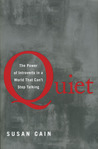
Review: Quiet: The Power of Introverts in a World That Can't Stop Talking

Quiet: The Power of Introverts in a World That Can't Stop TalkingQuiet: The Power of Introverts in a World That Can't Stop Talking by Susan Cain
My rating: 4 of 5 stars

"People work real hard at looking like extroverts, whether that’s comfortable or not."

As a person scoring around 70/30 on extrovert/introvert scale I was primarily interested in reading this book to better understand the inner world of many of my colleagues as well as former (and perhaps future) students who are more introverts than myself.

It's a very good guide into the topic. It challenges common practices such as open offices, organising work around teams sitting and doing things together, brainstorming sessions, pupil learning organised around groups and so on.

In particular, I found revealing connection between introversion and innovation (which isn't surprising really):

"Introverts prefer to work independently, and solitude can be a catalyst to innovation."

"In many fields, it’s only when you’re alone that you can engage in Deliberate Practice, which is identified as the key to exceptional achievement."
The famous study by DeMarco and Lister made on productivity of software engineers confirms that: the social interruptions are the biggest barriers to productivity.

And I liked another angle to what leadership really is - it's not only about standing on the stage and making motivating speeches to the ecstatic crowds of followers. Leadership...

...also occurs in more solitary situations such as developing new techniques in the arts, creating new philosophies, writing profound books and making scientific breakthroughs.
The criticism of a very common collaborative practice - brainstorming - has been very refreshing too. It makes people feel good since it makes them feel more attached. However, it does not allow for more creative ideas - it often rather means more conformism, more production blocking (only one person can talk or produce an idea at once) and more fear of looking stupid in front of others.

The notion of the highly sensitive people (which often are introverts) was also well explained and substantiated. As leaders we better appreciate and make more use of such type of people.

All the self-help advice for introverts ("how to thrive in the world dominated by extroverts") was not that interesting to me and there was a bit too much of it to my taste. A lot of that is also more relevant for the US readers as opposed to the Northern Europe where I live.

All in all, a high quality book explaining importance of certain psychological aspects in our workplaces, relationships and classrooms. Particularly recommended for leaders/managers and teachers.